Grinding brushes are industrial brush tools used in equipment such as double-sided polishing machines, sweeping machines, and grinding machines. They are core components of surface finishing equipment and are mainly used in industrial processing fields such as stone, metal, glass, electronic components, and automotive parts.
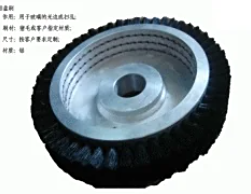
Its core structure consists of a base, abrasive filaments, and a fixing boss. The filaments can be made of dozens of materials such as nylon, abrasive filaments, and ceramic fibers. They are made into brush wheels or brush rollers through processes such as stamping and welding reinforcement. The density and arrangement can be adjusted to achieve polishing, deburring, or matte effects. The brush body is mostly made of aluminum disc, epoxy resin board, or PVC board, which is compatible with various industrial equipment models. It has the characteristics of acid and alkali resistance, high elasticity, and re-filament planting. It is suitable for curved surface grinding and complex surface treatment in dry and wet environments. It is commonly used in mobile phone glass polishing, automobile wheel hub repair, and other scenarios.
Product Introduction
The grinding brush includes a base with several mounting grooves on one side, each containing a grinding wire. A fixing boss is located on the other side of the base. When this type of grinding brush grinds a stone surface, the ends of each grinding wire individually contact the stone surface, thus dispersing the grinding surface between the brush and the stone. The grinding brush is fixed to the swing arm of the grinding machine by the fixing boss on one side. The brush creates the desired grinding marks on the stone surface as the swing arm swings in different directions. By changing the shape of the grooves for mounting the grinding wires and the thickness and length of the grinding wires, different grinding effects can be achieved on the stone surface, such as a textured surface, an antique finish, or a matte finish.
The manufacturing process of a grinding brush involves cutting a steel shaft to the appropriate size, machining a blank on a machine tool, welding, reinforcing, and straightening it, and then machining a prototype roller core on a lathe. Depending on the requirements, a sleeve is then fitted onto the roller core prototype, or it is directly injection molded into a mold. This completes the basic shape of a brush roller. The injection-molded or sleeved roller blank is then precision-machined on a machine tool according to the dimensions specified in the drawings. Subsequent processing is performed according to different process requirements, such as fine grinding of the rubber-coated roller core, and the fabrication of different keyways or interfaces on the shaft end.
Technical parameters
1. Brush bristles: pig bristles, horse bristles , wool , DuPont bristles, nylon, PP, red/white polished leather, sisal, buffing, abrasive bristles, and leather/fur blends.
2. Industries using this technology: mobile phones, tablets, touch screens, windows, LCD screens , and watches.
3. Applications: Glass, lenses, tempered glass , and hardened glass.
4. Usage environment/conditions: Suitable for double-sided polishing machines /broom polishing machines/grinding machines/mills, etc.
5. Equipment models: 9S/9B/13S/13B/15S/15B/16S/16B/18B/20B, etc.
6. Product shape: disc/round/irregular shape.
7. Brush body material: aluminum disc/PVC board/epoxy resin board, etc.
8. Functions: Sweeping, polishing, edge sweeping, edge finishing, hole sweeping, hole finishing, surface sweeping, surface finishing, grinding, finishing, and deburring.
9. Category: Industrial brushes.
10. Bristle length: 12mm/15mm/17mm/20mm/23mm/25mm/27mm/30mm/32mm/35mm, etc.
Product Features
1. It has good resistance to acids and alkalis, good resistance to chemical organic solvents, does not damage the original surface gloss, and has low water absorption, making it suitable for both dry and wet conditions.
2. High durability, strong bristles, and long service life.
3. The bristles are strong and durable, suitable for various surfaces such as double-curved surfaces and uneven surfaces.
4. It can be reused and the bristles can be re-inserted.
Product Material: The key to judging the quality of a brush is the texture of the bristles. The bristles should have a natural, curved shape, and the entire brush needs to be manually trimmed. For example, angled contour brushes and rounded powder brushes require multiple, even trimming layers to achieve a perfectly applied makeup look without any stinging sensation during use.
Product Application
1. Finishing of cold-rolled steel sheets and galvanized/tin-plated steel sheets before and after processing.
2. Remove burrs and chamfer after machining.
3. Finishing of refrigerator/ air conditioner compressor parts
4. Post-treatment of copper/aluminum strip coil surfaces
5. Cleaning and grinding of copper plates in electronic circuit boards
6. Deburring and surface grinding of automotive gears/engine parts before electroplating and painting
7. Surface grinding of castings and deburring of deep holes/related holes.
8. Woodworking/Plywood surface finishing/Enhancing the grain of complex furniture wood/Sanding uneven curved surfaces
9. Polishing of hydraulic component cylinder liner surface and terminal surface
Production method
1. Continuously wrap the fixing plate with the implanted bristles around the shaft, and then fix it.
2. Method of fixing the bristle fixing plate to the shaft:
3. Use a special fixing device to fix the shaft to the screw.
4. Fix it to the shaft using welding.
Post time: Nov-06-2025